
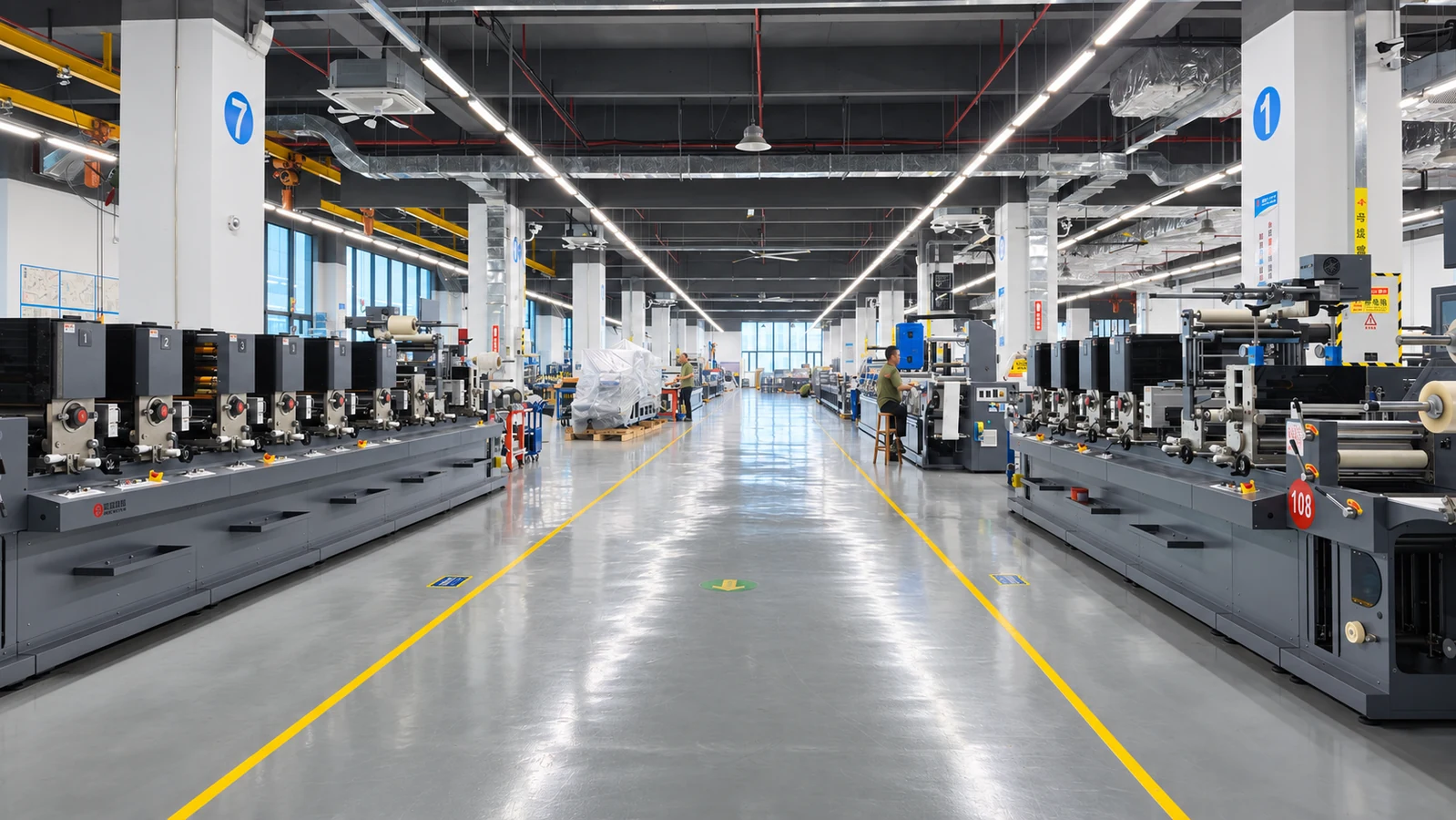
1. Start with the job mix
Short-run custom label production involves more than a small order length. When artwork, repeats, colours and finishing change frequently, preparation, changeovers and acceptable output can matter as much as maximum press speed.
An intermittent flexo press coordinates web feed with the printing cycle to vary the print repeat within its supported range. Include it in evaluations of varied jobs and changing repeats, alongside full-rotary flexo and digital printing. Longer repeat orders can benefit from continuous full-rotary operation; very small quantities, frequent artwork changes or variable data may favour digital printing.
Compare actual jobs using preparation time, changeover time, sustained running speed, finishing and the final acceptable quantity. No single order length determines the best process for every label converter.
2. Web handling and tension during intermittent motion
During image transfer, the substrate and plate surface move together. Between impressions, the feed mechanism repositions the web for the next repeat. Web behaviour during acceleration, deceleration and positioning is therefore an important part of a register and print-stability evaluation.
The web path, traction control, tension measurement and web guiding need to work together. Films and thin papers also require a review of material construction, thickness, heat response and curing. A servo or straight-web-path description alone does not demonstrate reliable production on a particular substrate.
Current HCF documentation lists automatic web guiding, a web viewing camera and second-pass printing. Automatic register and pre-register are options to discuss. Confirm the specific control package and included equipment in the selected machine specification.
- Observe register at startup, steady running, speed changes and restart.
- Test the actual substrate and record width, thickness, repeat, colours and curing.
- Describe web transport, guiding and register separately rather than treating them as one function.
3. Sleeve-type tooling and the changeover workflow
HCF350 and HCF450 use sleeve-type plate cylinders. For frequent job changes, review plate and tooling preparation, removal, positioning and reuse. Intermittent operation can change the print length within the supported range without matching every repeat to a different cylinder circumference. Plates and finishing tools must still suit the job.
Assess the workflow in practice: what can be prepared off press, which tools are needed, how long register recovery takes and whether operators can repeat the same procedure consistently.
Running stability also involves assembly accuracy, locking, transmission and control, frame stiffness and rotating-part balance. A structural description does not replace a test. Compare presses with the same substrate, artwork, operating conditions and acceptance criteria.
4. Fine print depends on the complete printing system
Small text, gradients, highlights and fine lines depend on plate preparation, ink delivery, impression, substrate condition and curing. Select plate materials against artwork, inks, substrates and the processing method. Aqueous and other plate-processing methods have their own application conditions; the processing method alone does not determine the printed result.
Match impression to the plate, mounting tape and substrate. Examine samples for dot gain, filled detail and distortion, as well as missing ink, lost highlights and incomplete lines. One best sample does not establish sustained capability across different jobs.
For demanding screen rulings or small highlight dots, agree the target artwork, measurement method and acceptance conditions before a trial. Record the plate, anilox, ink, substrate, speed and sample results to establish whether acceptable output is repeatable under the same conditions.
5. G7 colour management and the scope of qualification
Guangzhou Hochen Machinery Technology Co., Ltd. holds a G7 Master Facility Colorspace qualification certificate. G7 calibration uses gray balance and tonal targets to provide a shared basis for colour consistency in print production.
G7 Master qualification relates to the facility and devices submitted for evaluation. It does not establish that every press sold, substrate or ink combination automatically meets the same verification. The certificate also does not replace process control, measurement and regular calibration in the customer's factory.
For labels that need consistency across batches, agree the customer's colour targets, measurement conditions and tolerances before proofing and production validation. Substrates, inks and operating conditions still need control. Use records and measurements to make production procedures repeatable.
6. Select inline finishing around the label construction
Evaluate the press as part of the finishing workflow. Current HCF information lists cold foil, rotary die cutting, intermittent lamination, adhesive-side printing and screen printing as options to discuss, together with LED UV and cooling arrangements suited to the substrate.
These options are configuration discussion items. They are not all included in a base machine or guaranteed to operate simultaneously in every combination. Confirm each module's supported mode, repeat, material conditions, synchronisation and effect on line speed.
Compare inline and separate processing using the complete workflow: a second pass, register, material transfers, waiting work and tooling preparation. Additional offset, letterpress or digital inkjet processes require a separate engineering review and an agreed acceptance scope.
7. HCF350 / HCF450: usable format before speed
| Specification | HCF350 | HCF450 |
|---|---|---|
| Maximum material width | 350 mm · 13.78 in | 450 mm · 17.72 in |
| Maximum intermittent print area (width × repeat) | 340 × 370 mm · 13.39 × 14.57 in | 440 × 450 mm · 17.32 × 17.72 in |
| Printing units | 2–12 colours | 2–12 colours |
| Plate cylinder structure | Sleeve type | Sleeve type |
| Maximum print speed | Up to 60 m/min; conditions depend on mode, substrate and configuration | |
Maximum web width and maximum intermittent print area are different specifications. The substrate may also need trim, register marks and allowance for finishing, so its entire width is not necessarily available for artwork.
The HCF series currently lists a maximum print speed of 60 m/min. Actual speed depends on substrate, print repeat, colours and configuration; confirm conditions for the chosen operating mode. Printing cycles and net material output are different measurements and should not be treated as equivalent.
For short jobs, evaluate total time from preparation to acceptable finished labels. Maximum speed needs to be considered together with sustained average speed, setup, waste and finishing capacity.
8. Turn the technical discussion into a verifiable specification
Intermittent flexo's application value depends on the job, process and acceptance conditions. A trial with representative artwork and substrates, followed by a comparison of changeovers, register, colour, curing and finishing, is more useful than an unqualified speed or savings claim.
To discuss a Hochen configuration, provide the substrate and thickness, web width, label dimensions and repeat, colours, typical order lengths, finishing and installation country. Agree the equipment, tooling, installation, training and spare-parts scope in the proposed specification.
- Before the trial: agree artwork, substrates, operating mode and quality checks.
- During the trial: record speed, preparation, waste, stops and acceptable output.
- After selection: include the agreed configuration, trial results and acceptance requirements in the technical proposal.